The Bug That Behaved Perfectly: Why Agentic Apps Are So Hard to Debug
TL;DR
This is the story of a bug that behaved perfectly. After we migrated DepsRAG from Langroid to Agno, the AssistantAgent—the agent designed to orchestrate the entire workflow—was never invoked, yet every answer stayed correct: Agno’s Team construct provides an implicit coordinator that absorbed the AssistantAgent’s orchestration instructions through its prompt, making the agent redundant without breaking anything. Traditional debugging tools have little to offer here—breakpoints, stack traces, and tests all assume a symptom to chase, and this defect produced none. Agentic applications need a new kind of debugging tooling: one that understands the semantics of the underlying framework and verifies the application’s structure before deployment, not just its behavior at runtime. That is how we caught this bug—with a pre-deployment analysis tool we are developing that visualized DepsRAG’s actual topology; the fix is now merged in DepsRAG.
Introduction
There is a class of bugs in multi-agent applications that produces no wrong answers, no exceptions, and no failed tests. The system does exactly what you designed it to do—just not the way you designed it to. This post is about one of those bugs: how it was introduced during a framework migration, why every behavioral signal looked healthy, and how it finally surfaced.
The subject is DepsRAG [1], our multi-agent system for reasoning about software dependency graphs. DepsRAG builds a package’s dependency graph in Neo4j, then answers questions about it—including vulnerability lookups—by coordinating several specialized agents.
DepsRAG’s Architecture
DepsRAG was originally built on Langroid, where orchestration is explicit: you designate an agent as the orchestrator and wire the delegation hierarchy yourself. The design had four agents:
- AssistantAgent: the orchestrator. It receives the user’s question, breaks it into sub-questions, delegates to the workers, and synthesizes the final answer.
- DependencyGraphAgent: constructs the dependency graph in Neo4j and runs Cypher queries against it.
- SearchAgent: performs web searches and vulnerability lookups.
- CriticAgent: reviews every answer before it reaches the user.
In Langroid, this hierarchy is spelled out in code. The AssistantAgent’s task owns the workers as sub-tasks, and running the app means running the AssistantAgent:
assistant_task = lr.Task(assistant_agent, ...)
...
assistant_task.add_sub_task([dependency_task, search_task, critic_task])
assistant_task.run(question)
The AssistantAgent is load-bearing. Remove it and nothing coordinates the workers—the app simply doesn’t function.
The Migration to Agno
We later migrated DepsRAG to Agno (PR #9). The port looked like the obvious 1:1 mapping: each Langroid agent became an Agno Agent, and all four were placed into an Agno Team in coordinate mode:
team = Team(
    name="DepsRAG",
    model=model,
    members=[assistant, dependency_agent, search_agent, critic],
    mode=TeamMode.coordinate,  # Assistant coordinates member agents
    ...
)
Note the comment—it records what we believed was happening. The AssistantAgent kept its full orchestration brief in its role:
Agent(
    name="AssistantAgent",
    role="""...
1. Guide users through the process of creating and analyzing dependency graphs
2. Validate that dependency graph creation succeeds before proceeding
3. Break down complex questions into simpler sub-questions
4. Coordinate with DependencyGraphAgent, SearchAgent, and CriticAgent
5. Synthesize information from multiple sources into comprehensive answers
...""",
    tools=[],
    ...
)
The migrated app worked. Graph construction, dependency questions, vulnerability checks, critic review—all correct. The tests passed. We moved on.
What the Topology Actually Looked Like
The redundancy surfaced only when we ran DepsRAG through a pre-deployment analysis tool we are currently developing. The tool statically extracts a multi-agent application’s topology—agents, tools, and delegation paths—and, crucially, it understands the semantics of the agentic framework underneath, not just the code that names the agents.
That last part matters here, because Agno’s Team in coordinate mode creates an implicit coordinator: the team’s own model acts as a team leader that receives the user’s query and delegates to members. This coordinator doesn’t appear anywhere in your code as an agent—it is a framework-level construct. A topology extractor that only parses your agent definitions would never draw it.
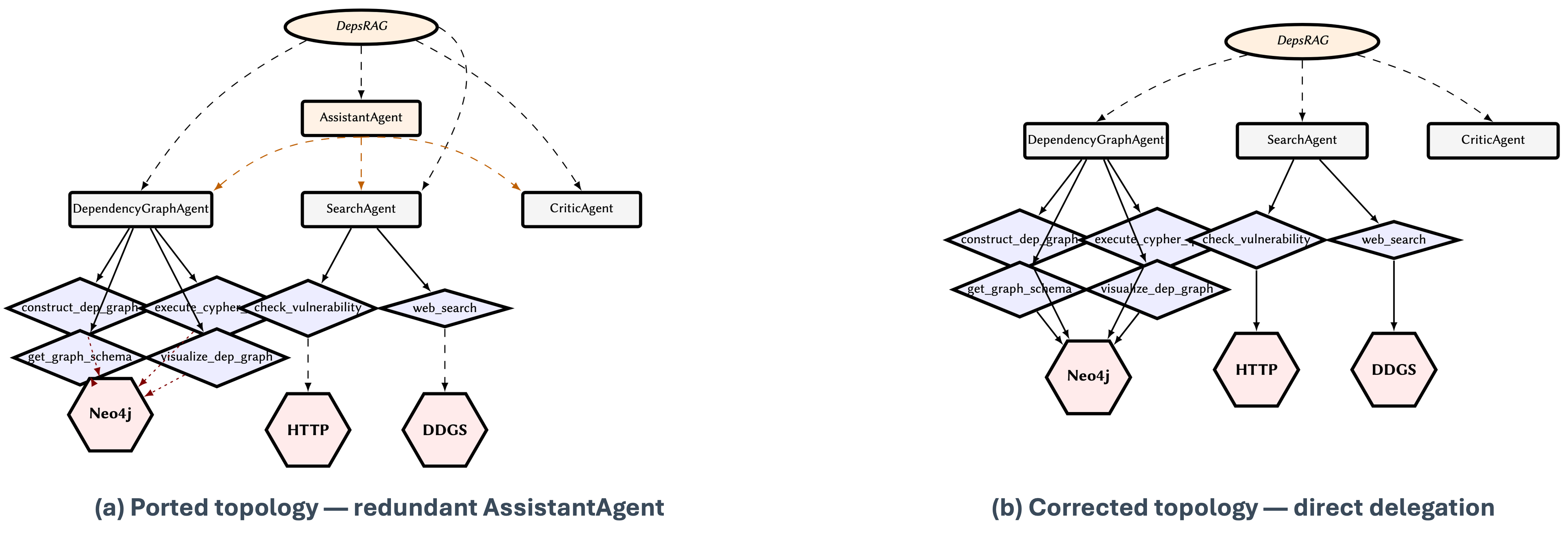
The visualization made the problem obvious in a way the code never did. In topology (a), the AssistantAgent sits as a member under the implicit coordinator—a coordinator reporting to a coordinator. It owns no tools (the Neo4j, HTTP, and DuckDuckGo tools all belong to the workers), and the workers it was designed to orchestrate are its siblings, not its subordinates. It is structurally redundant.
Confirming It at Runtime
A suspicious topology is a hypothesis, not a diagnosis. To understand how DepsRAG actually behaved with this structure, we collected runtime traces using Agno’s built-in telemetry plus custom logging around agent invocations, and ran our usual workloads.
The traces showed two things:
- The AssistantAgent was never invoked. Zero calls, across every session. The implicit coordinator delegated directly to DependencyGraphAgent, SearchAgent, and CriticAgent—exactly the delegation pattern in topology (b), even though the code expressed topology (a).
- The system’s behavior was still correct. Graph validation happened before analysis, complex questions were decomposed, and the CriticAgent reviewed answers before delivery—all the responsibilities we had assigned to the AssistantAgent were being carried out. By something else.
A dead agent and a correct system. That combination is what makes this bug interesting.
Why the Bug Was Invisible
The answer is in how Agno assembles the coordinator’s prompt. When a Team runs in coordinate mode (Agno 2.5), the team leader’s system message embeds a description of every member—including each member’s role—so the leader knows who to delegate to:
# agno/team/_messages.py (abridged)
content += f'<member id="{member_id}" name="{member.name}">\n'
if member.role is not None:
    content += f"  Role: {member.role}\n"
if member.description is not None:
    content += f"  Description: {member.description}\n"
Recall what the AssistantAgent’s role contained: the entire orchestration workflow—validate graph creation before proceeding, decompose complex questions, always route answers through the CriticAgent. All of that text was injected verbatim into the implicit coordinator’s system prompt as a member description.
So the coordinator read a member profile that spelled out, step by step, how to orchestrate this team—and simply executed that workflow itself. Agno even licenses this choice explicitly; the leader’s system prompt opens with:
“You coordinate a team of specialized AI agents to fulfill the user’s request. Delegate to members when their expertise or tools are needed. For straightforward requests you can handle directly — including using your own tools — respond without delegating.”
From the coordinator’s perspective, delegating to the AssistantAgent was never a rational choice: the member had no tools, and its stated job was the one the coordinator was already doing—and permitted to keep doing. The framework’s prompt-assembly mechanics quietly transferred the dead agent’s responsibilities to the component that made it dead.
This is why every behavioral test passed. The orchestration logic survived the migration perfectly. Only the orchestration structure didn’t—and none of our testing observed structure.
The Fix
The fix (PR #21) makes the implicit coordinator’s job official. The AssistantAgent is removed entirely, and its orchestration guidance moves to where it was already being consumed—the team level:
team = Team(
    name="DepsRAG",
    model=model,
    members=[dependency_agent, search_agent, critic],
    mode=TeamMode.coordinate,
    instructions=[
        "Delegate graph creation to DependencyGraphAgent, then verify success",
        "Route web and vulnerability questions to SearchAgent",
        "Break complex user requests into clear, self-contained subtasks",
        "Before responding to the user, ALWAYS delegate to CriticAgent",
        ...
    ],
)
Behavior is unchanged—which is the point. The code now says what the system was already doing.
One might ask: if behavior was correct, why fix it at all? Because a redundant agent is not free:
- Token and latency overhead. The AssistantAgent’s full 30-line role was injected into the coordinator’s system prompt on every single run, for an agent that contributed nothing.
- Misleading architecture. Anyone reading the code—or debugging an incident—would reason about a delegation path that doesn’t exist. The comment
# Assistant coordinates member agentswas actively false. - Fragile correctness. The system worked because of an undocumented prompt-assembly detail. An Agno update that changed how member roles are shared with the leader could have silently dropped the orchestration logic—graph validation, critic review—with no code change on our side.
- A larger surface. Every agent in a topology is a delegation target the coordinator may choose. A dead agent that could occasionally come alive under unusual prompts is a reliability and security liability, not a neutral bystander.
The Broader Lesson: Behavior Is Not Enough
Stepping back, three things about this bug generalize well beyond DepsRAG.
Framework migrations are not 1:1 mappings. Agentic frameworks disagree on a fundamental design question: is orchestration something you build (Langroid’s explicit orchestrator agent) or something you get (Agno’s implicit team coordinator)? A migration that maps agent-to-agent without mapping orchestration model to orchestration model will produce exactly this kind of structural bug. The same trap exists in other directions—porting to frameworks with graph-based control flow, supervisor patterns, or handoff semantics each redraws the topology in ways the agent definitions alone don’t reveal.
Traditional debugging has no entry point for symptomless bugs. Debuggers, stack traces, and test suites are built for defects that manifest—a wrong value, an exception, a failing assertion. Our test suite validated answers, not delegation paths, so it had no way to fail: the answers were right. And in an agentic app, the control flow a debugger would step through is not in your code at all—it emerges from prompts the framework assembles and from an LLM’s delegation decisions at runtime. Bugs like this need a different kind of tooling: structural verification that asks, before deployment, whether the topology the code implies matches the topology the framework will actually execute. After deployment, there is no symptom to chase.
Topology extraction must understand framework semantics. The redundancy was only visible because the analysis knew that Agno’s Team(mode=coordinate) spawns an implicit coordinator and that member roles are folded into its prompt. A framework-agnostic view of the code—four agents, some tools—looks perfectly reasonable. It is the framework’s runtime semantics that turn the design into a bug, so it is framework semantics that pre-deployment analysis has to model. This is precisely the gap the pre-deployment verification tool we are building aims to close, and DepsRAG has become one of its first real case studies.
Takeaways
If you maintain a multi-agent application, three concrete practices follow from this experience:
- Before migrating, write down the target framework’s implicit orchestration. List what its team/graph/supervisor constructs already do—coordination, routing, synthesis—then decide which of your agents still need to exist. Map orchestration model to orchestration model, not agent to agent.
- Alert on zero-invocation agents. Track per-agent invocation counts in your traces and treat a permanently idle agent like dead code in a coverage report: either remove it or explain it.
- Inspect the prompts your framework assembles, not just the ones you write. What each agent is told about the others determines where responsibilities actually land at runtime.
References
[1] Mohannad Alhanahnah and Yazan Boshmaf. “DepsRAG: Towards Agentic Reasoning and Planning for Software Dependency Management.” NeurIPS 2024 Workshop on Open-World Agents, 2024.
[2] DepsRAG repository.
[3] Langroid: Multi-Agent Programming Framework.
[4] Agno: Framework for Building Multi-Agent Systems.
[5] DepsRAG PR #9: Migrate DepsRAG from Langroid to Agno.
[6] DepsRAG PR #21: Refactor team orchestration and remove unused AssistantAgent path.